
Overview
In almost all forms of storytelling, the background and current state of mind of the audience members predispose them to experience a given story from a uniquely personal perspective. However, traditional story writers usually construct their narratives based on the average preferences of their audience, which does not guarantee satisfying narrative experiences for its members.
This project explores user modeling and adaptive storytelling to generate individualized interactive narratives based on individual preferences. The research investigates how personality traits can be used to predict narrative preferences and how interactive storytelling systems can automatically adapt story content to create personalized experiences that align with each user's psychological profile.

Research Challenges
- How can personality traits be mapped to narrative preferences in interactive storytelling?
- What methods can effectively assess user personality without disrupting the narrative experience?
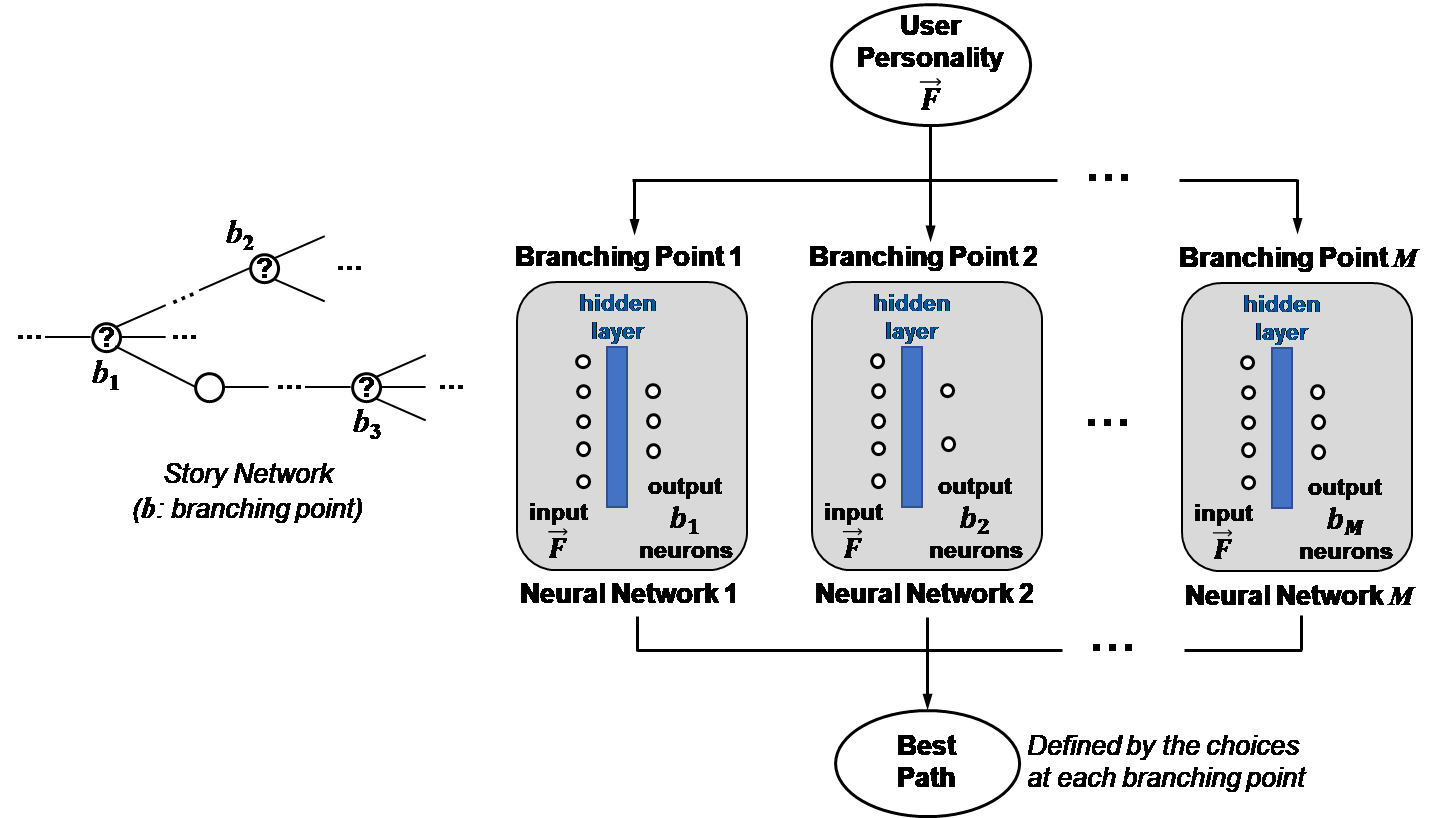
- How can machine learning predict player choices at narrative branching points based on personality?
- What balance should be maintained between personalization and narrative coherence?
- How can adaptive systems respond to user preferences in real-time during interactive experiences?
Approach
This research develops methods to create personalized narrative experiences by modeling user preferences through personality assessment. The approach uses the Big Five personality model, a well-established psychological framework measuring openness, conscientiousness, extraversion, agreeableness, and neuroticism, as the foundation for predicting narrative preferences.
The method employs a two-stage process: first, users' personality traits are assessed through brief questionnaires integrated into the interactive experience. These personality scores are then mapped to narrative preferences using artificial neural networks trained to predict which story choices users with specific personality profiles are likely to prefer at narrative branching points.
The research demonstrates how personality traits can be integrated into nondeterministic planning algorithms to define adaptive goal hierarchies. Neural networks are trained using gameplay data to predict player behaviors in real-time, allowing planning operators to use both personality traits and predicted behaviors as logical terms in their preconditions, creating richer individualized experiences.
The approach has been validated through interactive storytelling systems where narratives automatically adapt based on user personality profiles. Results show that the method can accurately recognize user preferences for story events and positively improve user satisfaction and overall narrative experience.
Key Contributions
Developed methods to map Big Five personality traits to narrative preferences using artificial neural networks, enabling the prediction of user choices at story branching points based on personality profiles.
Created systems that automatically generate individualized interactive narratives by adapting story content, plot progression, and character interactions according to user personality traits and predicted preferences.
Prototypes
Interactive storytelling prototypes were used to validate personality-based narrative adaptation:

Related Publications
-
Edirlei Soares de Lima; Bruno Feijó; Antonio L. Furtado. Adaptive Storytelling Based on Personality and Preference Modeling. Entertainment Computing, Volume 34, May 2020, 100342, 2020. [DOI]
-
🏆 Best Paper Award Edirlei Soares de Lima; Bruno Feijó; Antonio L. Furtado; Vinícius Michel Gottin. Personality and Preference Modeling for Adaptive Storytelling. Proceedings of the XVII Brazilian Symposium on Computer Games and Digital Entertainment (SBGames 2018), Foz do Iguaçu, Brazil, pp. 538-547, 2018. [PDF] [DOI]