
Overview
Quests are a fundamental storytelling mechanism used by computer role-playing games (RPGs) to engage and involve players in the game's narrative. Although RPGs have evolved in many ways in recent years, their basic narrative structure is still based on static plots manually created by game designers. This creates significant limitations for truly dynamic and responsive interactive experiences.
This project explores the procedural generation of dynamic and interactive quests for games, addressing challenges such as maintaining narrative coherence in highly interactive game worlds, managing complex character interactions, supporting multiple quest endings, and creating narratives that are both algorithmically generated and emotionally compelling. The research investigates how automated planning, evolutionary computation, and player modeling can enable quest generation systems that adapt to player actions and preferences.

Research Challenges
- How can we generate branching quest structures that maintain narrative coherence across multiple possible player paths?
- What methods can effectively handle nondeterministic events in dynamic game worlds while preserving story quality?
- How can character-based approaches be integrated with plot-based methods to create compelling interactive narratives?
- What role can player modeling play in adapting quest content to individual player preferences and behaviors?
- How can we develop authoring tools that support narrative designers without requiring programming expertise?
Approach
This research investigates multiple approaches to procedural quest generation, each addressing different aspects of the narrative generation challenge. The work explores how automated planning can be combined with evolutionary algorithms to generate quest structures that follow specific narrative arcs and dramatic patterns.
A key direction examines character-based narrative generation, where multi-agent planning is integrated with drama management strategies to handle complex character interactions and emergent storytelling. This approach supports the generation of narratives where character goals and motivations drive the plot forward, creating more dynamic and responsive story experiences.
The research also investigates player modeling techniques to personalize quest content. By assessing player personality traits using models such as the Big Five factors and predicting player behaviors through machine learning, the methods can adapt quest structures, difficulty, and narrative content to individual players. This enables the generation of individualized interactive narratives that respond to player preferences and playstyles.
Additionally, the project develops authoring tools that allow narrative designers to create and manage interactive quest structures using intuitive graphical interfaces, without requiring programming knowledge. These tools support the specification of character goals, narrative structures, and dramatic constraints that guide the generation process.

Key Contributions
Developed methods combining genetic algorithms with automated planning to generate coherent branching quests guided by narrative arcs, producing results comparable to professionally designed content.
Created approaches that combine multi-agent planning with drama management strategies to generate and control character-based interactive narratives in highly interactive game environments.
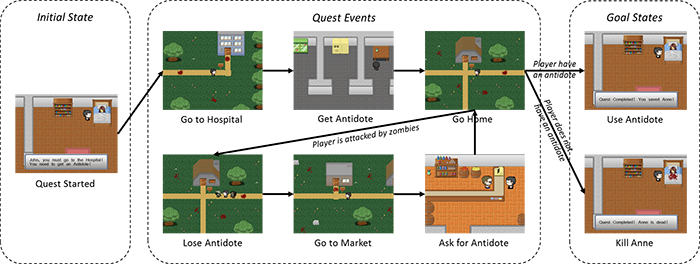
Proposed methods for handling nondeterministic events through planning, execution, and monitoring, enabling quests with multiple endings that meaningfully affect the game's ongoing narrative.
Developed player modeling techniques using the Big Five personality factors and behavioral prediction to generate individualized quest experiences tailored to player preferences and personality traits.
Created graphical authoring tools that enable narrative designers to develop character-based interactive narratives using intuitive diagrams and interfaces, without requiring programming knowledge.
Prototype Demonstration
Watch a demonstration of the prototype that combines multi-agent planning with drama management strategies to generate and control character-based interactive narratives in interactive game environments:
Related Publications
-
Edirlei Soares de Lima; Bruno Feijó; Antonio L. Furtado. Managing the Plot Structure of Character-based Interactive Narratives in Games. Entertainment Computing, Volume 47, 100590, 2023. PDFDOI
-
Edirlei Soares de Lima; Bruno Feijó; Antonio L. Furtado. Procedural Generation of Branching Quests for Games. Entertainment Computing, Volume 43, 100491, 2022. PDFDOI
-
🏆 Best Paper Award Edirlei Soares de Lima; Bruno Feijó; Antonio L. Furtado. A Character-based Model for Interactive Storytelling in Games. Proceedings of the XXI Brazilian Symposium on Computer Games and Digital Entertainment (SBGames 2022), Natal, Brazil, pp. 1-6, 2022. PDFDOI
 -
Edirlei Soares de Lima; Bruno Feijó; Antonio L. Furtado. Adaptive Branching Quests Based on Automated Planning and Story Arcs. Proceedings of the XX Brazilian Symposium on Computer Games and Digital Entertainment (SBGames 2021), Gramado, Brazil, 2021. PDFDOI
-
🏆 Best Paper Award Edirlei Soares de Lima; Bruno Feijó; Antonio L. Furtado. Procedural Generation of Quests for Games Using Genetic Algorithms and Automated Planning. Proceedings of the XVIII Brazilian Symposium on Computer Games and Digital Entertainment (SBGames 2019), Rio de Janeiro, Brazil, pp. 495-504, 2019. PDFDOI -
Edirlei Soares de Lima; Bruno Feijó; Antonio L. Furtado. Player Behavior and Personality Modeling for Interactive Storytelling in Games. Entertainment Computing, Volume 28, pp. 32-48, 2018. PDFDOI
-
🏆 Best Paper Award Edirlei Soares de Lima; Bruno Feijó; Antonio L. Furtado. Player Behavior Modeling for Interactive Storytelling in Games. Proceedings of the XV Brazilian Symposium on Computer Games and Digital Entertainment (SBGames 2016), São Paulo, Brazil, pp. 1-10, 2016. PDF -
Edirlei Soares de Lima; Bruno Feijó; Antonio L. Furtado. Hierarchical Generation of Dynamic and Nondeterministic Quests in Games. Proceedings of the International Conference on Advances in Computer Entertainment Technology (ACE 2014), Funchal, Portugal, 2014. PDFDOI