
Overview
In recent years, interactive narratives have emerged as a new form of digital entertainment, allowing users to interact and change stories according to their own desires. However, designing an interaction model for an interactive storytelling system involves several challenges, including the need for natural interaction interfaces and the ability to handle multi-user interactions.
This project explores the development and evaluation of diverse interaction methods for interactive storytelling systems. The research investigates how different modalities — from social networks and natural language to multimodal interfaces and interactive comics — can enable more engaging and accessible ways for users to participate in computational narratives.
Research Challenges
- How can social networks be effectively used as interaction platforms for collaborative storytelling?
- What natural language interfaces enable users to freely interact with virtual characters via text or speech?
- How can multimodal systems integrate multiple interaction methods while maintaining narrative coherence?
- What approaches enable multi-user interaction without requiring manually created branching story structures?
- How can interface design balance simplicity with robust interaction mechanisms that don't restrict creativity?
Approach
This research explores multiple interaction paradigms for interactive storytelling, each addressing different aspects of user engagement and narrative participation. The work investigates how emerging technologies and communication platforms can be adapted to create more natural and accessible interfaces for interactive narratives.
One direction examines social networks as interaction platforms, allowing users to influence stories through familiar social media interfaces. The system enables users to comment, suggest actions, and interact with narratives through platforms such as Facebook, Twitter, and Google+, using the functionalities of each platform (direct comments, hashtags, or posts) to communicate story preferences and influence plot development.
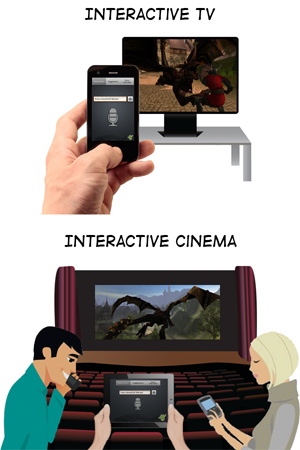
Another approach develops natural language interfaces for interactive television and cinema, enabling multi-user interaction through text or speech. Users can freely communicate with virtual characters using natural language, with the system processing suggestions and integrating them into the narrative generation process. This supports both local interaction through mobile devices and remote participation through broadcast media.
The research also investigates multimodal, multi-user, and adaptive interaction systems that integrate multiple input methods (speech, gestures, text, and sketches), creating flexible interaction servers that support diverse user preferences and capabilities while maintaining coherent narrative experiences across multiple simultaneous users.
A unique contribution is the development of non-branching interactive comics that generate dynamic narratives in comic book format. This approach allows user interaction and story variation without requiring manually created branching structures, enabling users to influence narrative outcomes while the system maintains visual and narrative continuity through procedural panel generation.

Key Contributions
Developed methods for using social networks as interaction platforms for interactive narratives, enabling users to influence stories through familiar social media interfaces and improving user satisfaction and experience.
Created multi-user natural language systems for interactive TV and cinema that allow users to freely interact with virtual characters via text or speech, supporting both local and remote participation in broadcast narratives.
Developed multimodal, multi-user, and adaptive interaction systems that integrate speech, gestures, text, and other input methods, creating flexible servers that support diverse user preferences while maintaining narrative coherence.
Created systems capable of generating dynamic interactive narratives in comic book format without relying on manually created branching structures, allowing user interaction while maintaining visual and narrative continuity through procedural generation.
Related Publications
-
Edirlei Soares de Lima; Bruno Feijó; Antonio L. Furtado; Simone D.J. Barbosa; Cesar T. Pozzer; Angelo E. M. Ciarlini. Non-Branching Interactive Comics. Proceedings of the International Conference on Advances in Computer Entertainment Technology (ACE 2013), Enschede, Netherlands, November 2013. [DOI] [PDF]
-
Edirlei Soares de Lima; Bruno Feijó; Cesar T. Pozzer; Angelo E. M. Ciarlini; Simone D.J. Barbosa; Antonio L. Furtado; Fabio A. Guilherme da Silva. Social Interaction for Interactive Storytelling. Proceedings of the 11th International Conference on Entertainment Computing (ICEC 2012), Bremen, Germany, September 2012, pp. 1-15. ISBN: 978-3-642-33541-9. [DOI] [PDF]
-
Edirlei Soares de Lima; Bruno Feijó; Antonio L. Furtado; Angelo E. M. Ciarlini; Cesar T. Pozzer; Fabio A. Guilherme da Silva. A Multi-User Natural Language Interface for Interactive Storytelling in TV and Cinema. Proceedings of the XI Brazilian Symposium on Computer Games and Digital Entertainment (SBGames 2012), Brasília, Brazil, November 2012. [PDF]
-
Edirlei Soares de Lima; Bruno Feijó; Simone Barbosa; Fabio A. Guilherme da Silva; Antonio L. Furtado; Cesar T. Pozzer; Angelo E. M. Ciarlini. Multimodal, Multi-User and Adaptive Interaction for Interactive Storytelling Applications. Proceedings of the X Brazilian Symposium on Computer Games and Digital Entertainment (SBGames 2011), Salvador, Brazil, November 2011. [PDF]