
Overview
An intriguing phenomenon in human storytelling is our ability to still recognize a story that the narrator has felt free to change to a considerable extent. Observing how folktales have appeared and been disseminated through different countries over the centuries, we notice that our favorite stories have evolved no less dramatically in the course of the oral storytelling tradition.
This project explores computational narratology to understand how narrative variants emerge and transform while maintaining recognizable core elements. Founded on the classification of types and motifs contained in the Aarne-Thompson-Uther Index, the research investigates the mechanisms underlying story variation and develops computational methods to generate new narrative variants systematically.

Research Challenges
- How can we characterize the mechanisms by which narrative variants emerge from original tales?
- What role do type interactions play in the formation of storytelling variants across cultures?
- How can semiotic relations be used to systematically generate new narrative variants while preserving coherence?
- What computational methods can effectively blend episodes from different stories to create coherent new narratives?
- How can narrative structure analysis inform the development of automated story generation systems?
Approach
This research develops computational methods to analyze and generate narrative variants based on theories from narratology, folklore studies, and semiotics. The work proposes that variants are often the consequence of type interactions, which can be characterized through semiotic relations expressing connection, similarity, unfolding, and opposition.
A central investigation explores how semiotic theory can provide systematic operations for creating story variants. The approach identifies four fundamental ways of composing new narratives from existing ones: along the syntagmatic axis through combination, along the paradigmatic axis through imitation, along the meronymic axis through expansion, and through opposition via antithetic reversal.
The research also investigates computational narrative blending, treating plot generation as a plan-generation problem. This method reuses existing stories to generate new narrative variants by combining and adapting episodes extracted from different stories that share the same narrative structure. By integrating plan validation algorithms with fundamental narrative structures, the approach ensures logical coherence while enabling creative variation.
A transdisciplinary perspective is also explored, integrating concepts from narratology, database design methodology, and computational linguistics to establish theoretical foundations for computational narratology as an emerging field. The research explores how network analysis techniques can aid in plot analysis and composition, providing tools to visualize narrative variants and support writers in the creative process.
Key Contributions
Proposed that narrative variants emerge through type interactions characterized by semiotic relations — connection (syntagmatic), similarity (paradigmatic), unfolding (meronymic), and opposition (antithetic) — providing a theoretical framework for understanding story evolution.
Developed planning-based methods to blend episodes from different stories sharing the same narrative structure, creating novel, coherent variants by combining elements from folklore, medieval romances, and modern games.
Applied the classification of folklore types and motifs from the Aarne-Thompson-Uther Index as a computational foundation for analyzing variant emergence in traditional storytelling.
Established conceptual foundations for computational narratology by integrating theories from narratology, database methodology, and computational linguistics, creating a unified framework for narrative analysis and generation.
Visualization Tool
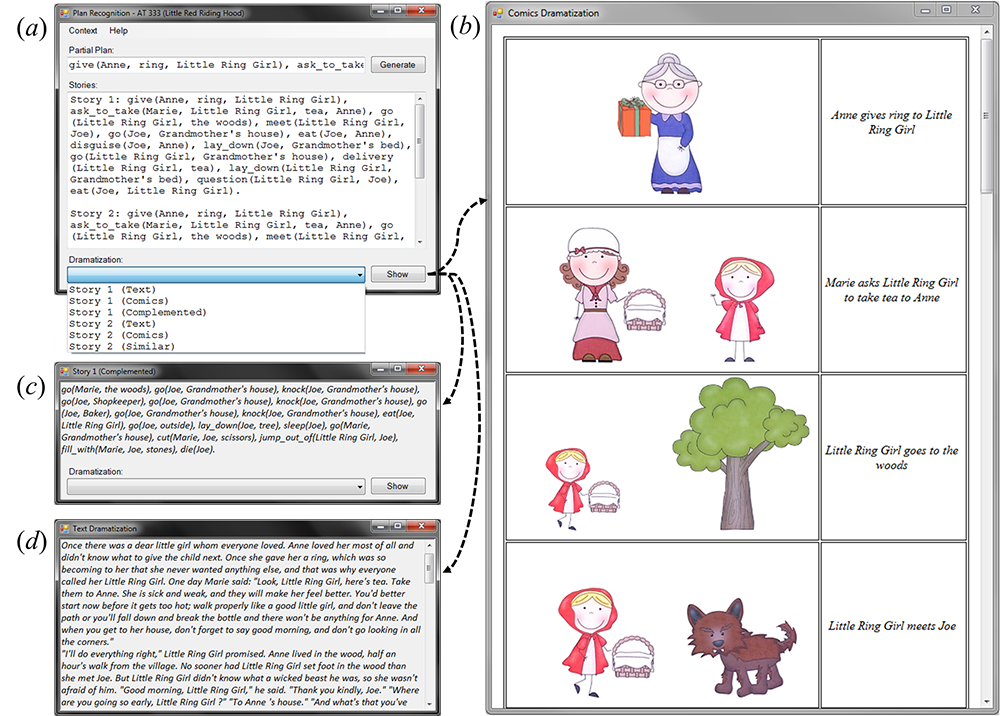
A specialized tool was developed for visualizing all possible narrative variants generated from a library of stories by applying semiotic operations. The tool helps writers explore different combinations, understand structural relationships, and compose new narratives.
Related Publications
-
Edirlei Soares de Lima; Bruno Feijó; Antonio L. Furtado. Computational Narrative Blending Based on Planning. 20th IFIP International Conference on Entertainment Computing (ICEC 2021), Coimbra, Portugal, Lecture Notes in Computer Science, Vol. 13056, p. 289-303, 2021. [DOI]
-
Bruno Feijó; Edirlei Soares de Lima; Antonio L. Furtado. A Transdisciplinary Approach to Computational Narratology. Proceedings of the XX Brazilian Symposium on Computer Games and Digital Entertainment (SBGames 2021), Gramado, Brazil, 2021. [PDF]
-
Edirlei Soares de Lima; Vinícius Michel Gottin; Bruno Feijó; Antonio L. Furtado. Network Traversal as an Aid to Plot Analysis and Composition. Proceedings of the XVI Brazilian Symposium on Computer Games and Digital Entertainment (SBGames 2017), Curitiba, Brazil, pp. 418-427, 2017. [PDF]
-
Edirlei Soares de Lima; Bruno Feijó; Marco A. Casanova; Antonio L. Furtado. Storytelling Variants Based on Semiotic Relations. Entertainment Computing, v. 17, p. 31-44, 2016. [DOI] [PDF]
-
🏆 Best Paper Award Edirlei Soares de Lima; Antonio L. Furtado; Bruno Feijó. Storytelling Variants: The Case of Little Red Riding Hood. Proceedings of the 14th International Conference on Entertainment Computing (ICEC 2015), Trondheim, Norway, pp. 286-300, 2015. [DOI] [PDF]
 -
Edirlei Soares de Lima; Antonio L. Furtado; Bruno Feijó. Types, Motifs and the Emergence of Variants. Proceedings of the XIV Brazilian Symposium on Computer Games and Digital Entertainment (SBGames 2015), Teresina, Brazil, p. 295-303, November 2015. ISSN: 2179-2259. [PDF]