
Overview
Fear is a basic human emotion that can be triggered by different situations, which vary from person to person. However, game developers usually design horror games based on a general knowledge of what most players fear, which does not guarantee a satisfying horror experience for everyone. While some fears are fundamental to human nature, such as fear of the unknown, more specific fears like darkness, apparitions, or confined spaces are highly individual.
This project explores new methods to create adaptive horror games that can identify what individual players fear and dynamically adjust game content to intensify those fears. The research investigates how player modeling, machine learning, and adaptive systems can be integrated into virtual reality horror games to create personalized frightening experiences that respond to each player's unique psychological profile.

Research Challenges
- How can we identify individual player fears using only gameplay data without explicit questionnaires?
- What machine learning techniques are most effective for modeling player fear responses in real-time?
- How can adaptive systems track horror intensity and dynamically moderate the use of fear-inducing elements?
- What role does virtual reality play in amplifying or modifying fear responses compared to traditional games?
- How can we balance adaptation to player fears while maintaining game difficulty and engagement?
Approach
This research develops methods for creating adaptive horror games that can personalize frightening experiences based on individual player characteristics. The approach combines player modeling techniques with machine learning to identify what specific horror elements trigger fear responses in different players.
A core component is the fear model, which maps gameplay observations to horror elements that provoke fear in players. The model uses machine learning techniques to analyze player behavior in response to different horror events, learning to predict which elements — such as darkness, apparitions, unknown sounds, or confined spaces — will be most effective for each individual player.
The research also explores adaptive agent-based systems that can track the horror intensity experienced by players throughout the game and dynamically moderate the use of fear-inducing elements. This enables the system to maintain appropriate pacing and prevent desensitization, while continuously adapting to changing player responses during gameplay.
Virtual reality technology plays a significant role in this research, as VR environments can amplify immersion and psychological presence, potentially intensifying fear responses. The project investigates how VR-specific elements and interaction methods can be used to create more effective adaptive horror experiences while maintaining real-time performance and player engagement.
Key Contributions
Developed machine learning methods to identify individual player fears using only gameplay observations, without requiring explicit questionnaires or physiological sensors, enabling unobtrusive fear assessment during gameplay.
Created an agent-based adaptive system for virtual reality horror games that tracks horror intensity experienced by players and dynamically moderates fear-inducing elements to maintain engagement while preventing desensitization.
Investigated the use of auditory elements in horror games from an audiological perspective, examining how sound design contributes to fear induction and can be adapted to enhance player-specific horror experiences.
Prototype Demonstration
Watch two gameplay sessions of the adaptive VR horror game prototype developed for this research project, alongside visualizations showing how player fear responses changed during gameplay:
Session Example 1: Stable Fear Response
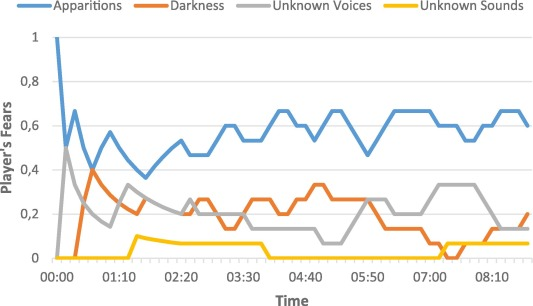
This example shows a participant with stable fear responses throughout the game session, with no considerable fear changes detected by the model during gameplay.
Session Example 2: Evolving Fear Response
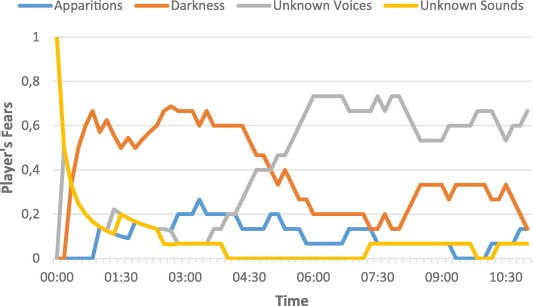
This example demonstrates a participant showing gradual transitions in fear responses during the game session, with the model detecting and adapting to changing fear patterns over time.
Related Publications
-
Edirlei Soares de Lima; Bruno Silva; Gabriel Galam. Adaptive Virtual Reality Horror Games Based on Machine Learning and Player Modeling. Entertainment Computing, Volume 43, August 2022, 100515, 2022. [DOI]
-
Edirlei Soares de Lima; Bruno Silva; Gabriel Galam. Towards the Design of Adaptive Virtual Reality Horror Games: A Model of Players' Fears Using Machine Learning and Player Modeling. Proceedings of the XIX Brazilian Symposium on Computer Games and Digital Entertainment (SBGames 2020), Recife, Brazil, pp. 366-372, 2020. [PDF] [DOI]
-
Thainá Cristina Demarque; Edirlei Soares de Lima. Auditory Hallucination: Audiological Perspective for Horror Games. Proceedings of the XII Brazilian Symposium on Computer Games and Digital Entertainment (SBGames 2013), São Paulo, Brazil, October 2013. [PDF]