

Artificial Intelligence
General Course Information
Edirlei Soares de Lima
<edirlei.lima@universidadeeuropeia.pt>

Artificial Intelligence
•
Professor: Edirlei Soares de Lima
–
Education:
•
•
•
B.Sc. in Computer Science – UnC
M.Sc. in Computer Science – UFSM
Ph.D. in Computer Science – PUC-Rio
–
–
Teaching Experience: PUC-Rio, UNIRIO, UERJ, UE-IADE
Game Experience:
•
•
•
Game Engines: RPG Builder, 3D Game Builder (http://www.3dgamebuilder.com.br/);
Research Projects: most are related with Logtell (http://www.icad.puc-rio.br/~logtell/);
Games: Krimson (Best Game Award at SBGames 2010 – Indie Game Development
Festival), and several other prototype games.
–
More Information: http://www.inf.puc-rio.br/~elima/
What is Artificial Intelligence?
•
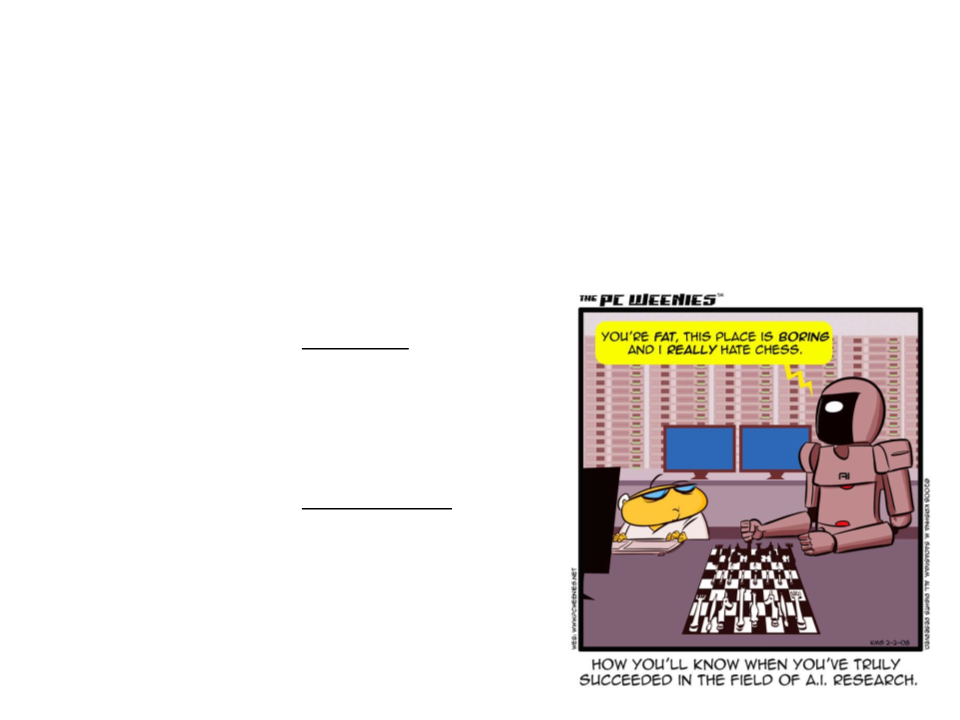
Artificial intelligence (AI) is about making computers able to
perform the thinking tasks that humans and animals are
capable of.
o Computers are very good at:
arithmetic, sorting, searching, play
some board games better than
humans, ...
o Computers are not very good at:
recognizing familiar faces, speaking
our own language, deciding what to
do next, being creative, ...

What is Game AI?
•
While academic AI concerns solving problems optimally, game
AI is all about entertaining players.
–
–
–
Complexity Fallacy: it is a common mistake to think that complex game
AI equals better character behavior.
Illusion of Intelligence: the player believes an agent is intelligent, then
it is intelligent.
Perception Window: most players will only come across some
characters and enemies for a short time.

Artificial Intelligence
•
•
Games & Apps Development – AI: learn common and
fundamental artificial intelligence concepts and techniques.
Module Content:
1
2
3
4
5
6
7
8
9
. Introduction to Artificial Intelligence;
. Pathfinding;
. Finite State Machines;
. Automated Planning;
. Randomness and Probability;
. Sensor Systems;
. Steering Behaviors for Autonomous Agents;
. Behavior Trees;
. Machine Learning.

Method
•
Active and experiential learning:
–
–
–
Theoretical concepts;
Practical examples;
Implementation exercises;
•
•
Game framework: Unity
Semester’s PBL team project:
–
Implementation of the game AI using the techniques learned during
the course.

Evaluation
•
Continuous Assessment (bipartite):
–
[50%] Intermediate assessment:
•
[60%] Individual exercises on the concepts learned;
•
[40%] Two intermediate deliveries of the team project (within the
semester’s PBL team project).
–
[50%] End of term assessment:
•
[100%] Final delivery of the team project (within the semester’s PBL team
project) with individual discussion.
•
Final Assessment:
–
[100%] Individual project development, delivery, and discussion.

Evaluation
•
Project Deliveries:
–
1st delivery: identification of the AI necessities:
•
•
•
Definition of the enemies/NPCs that require AI;
Description of the desired behaviors for the enemies/NPCs;
Identification of the AI techniques needed;
–
–
2nd delivery: working prototype with basic AI:
• Implementation of the AI for the main enemies/NPCs;
3rd delivery: final version with full implementation of the AI:
•
Full implementation and integration of the AI in the game.
Bibliography
•
•
•
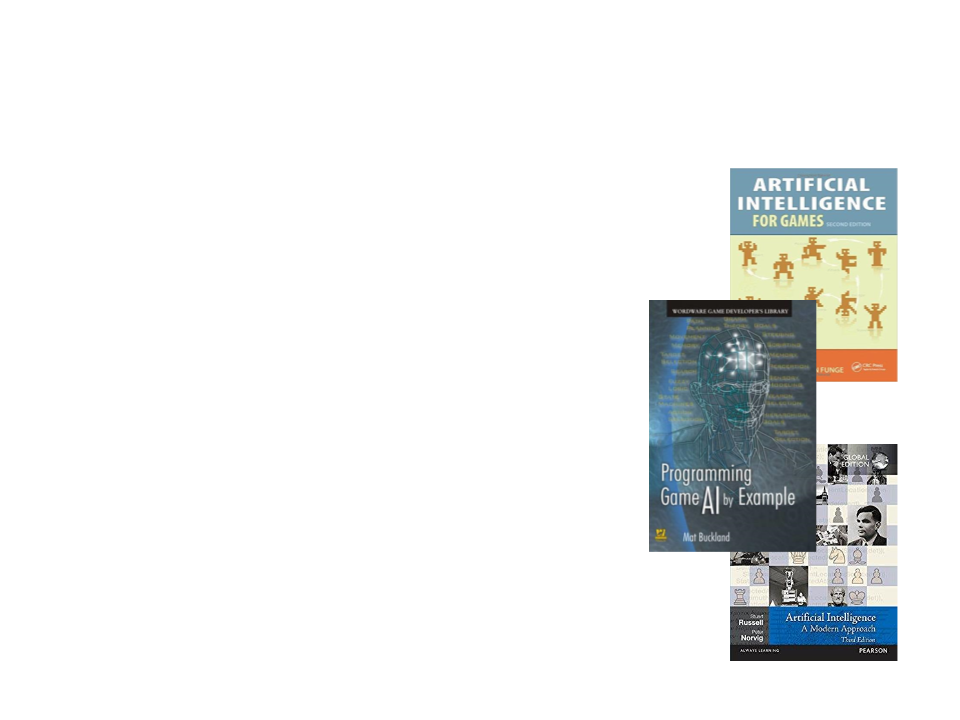
Millington, I., Funge, J. (2009). Artificial
Intelligence for Games (2nd ed.). CRC
Press. ISBN: 978-0123747310.
Buckland, M. (2004). Programming Game
AI by Example. Jones & Bartlett Learning.
ISBN: 978-1-55622-078-4.
Russell, S. and Norvig, P. (2009). Artificial
Intelligence: A Modern Approach (3rd
ed.). Prentice-Hall. ISBN: 0-13-604259-7.

Artificial Intelligence
•
•
Course webpage:
–
http://www.inf.puc-rio.br/~elima/game-ai/
Contact:
–
–
edirlei.slima@gmail.com